
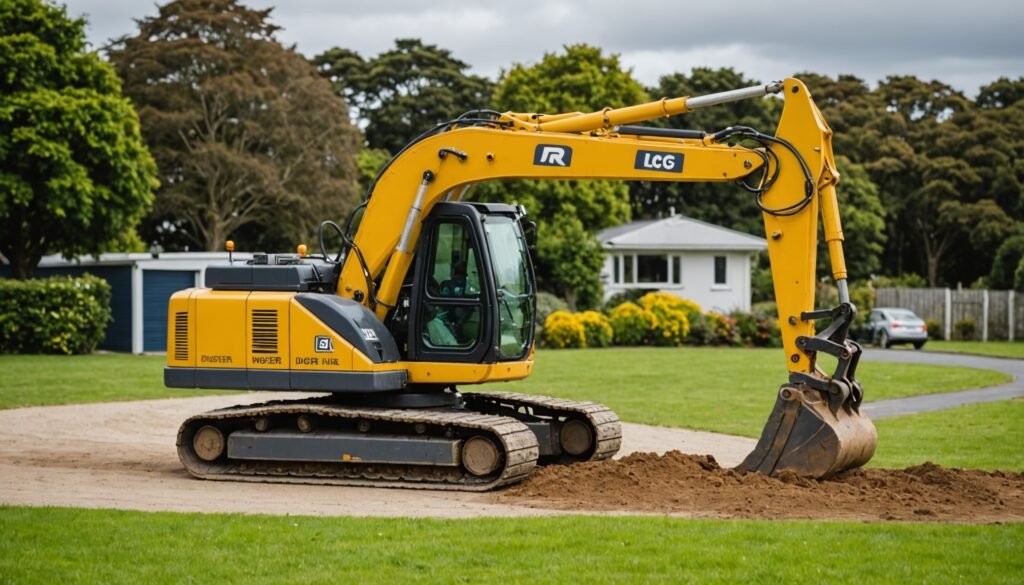
Getting the wrong digger on your Auckland site doesn’t just cost money—it costs time, creates safety risks, and leaves you dealing with equipment that can’t handle the conditions. Auckland’s volcanic soil, basalt rock, and clay present unique challenges that require matching the right machine to your specific project.
Whether you’re a homeowner planning a pool excavation or a contractor tackling commercial earthworks, understanding your digger hire Auckland options matters. From mini digger hire Auckland for tight access sites to larger excavator hire Auckland machines for heavy earthmoving, getting equipment sizing, hire rates, and site access right from the start saves thousands in delays and rework.
This guide walks you through what you need to know—machine sizing, pricing structures, operator requirements, and council consent considerations—so you can plan with confidence and get the job done right.
- Size matters: Match your digger to the job: Mini excavators (1.5-3.5T) handle residential landscaping and tight access sites, while larger machines tackle commercial earthworks and rock-breaking.
- Know hire rates to budget accurately: Daily rates suit short jobs, weekend packages offer savings, and monthly hires work for extended earthworks projects.
- Site access determines feasibility: Measure gates and clearance before booking—tight access sites require compact equipment or specialized attachments.
- Operator hire eliminates licensing barriers: Licensed professionals handle excavation safely, making it ideal for complex projects without certified operators.
- Ground conditions affect equipment selection: Auckland’s volcanic soil, basalt, and clay require appropriate machine power and attachments for effective digging.
Site Assessment: The Foundation of Efficient Digging
Before any earthmoving project begins, a thorough site assessment determines the success or failure of the operation. Understanding soil composition, underground utilities, and site access points allows operators to select appropriate equipment and techniques. In Auckland’s varied terrain, from volcanic soils in Mount Roskill to sandy coastal areas along the North Shore, soil conditions dramatically impact digging efficiency.
Professional operators conduct utility searches through BeforeUdig to locate underground services before excavation begins. This prevents costly service strikes that can halt projects for hours or days. A construction company in East Tamaki reduced project delays by 35% after implementing comprehensive pre-site surveys, saving approximately $48,000 in unexpected repair costs over a twelve-month period.
Matching Equipment to Project Requirements
Digger selection significantly impacts operational efficiency. Mini excavators excel in residential settings with limited access, while mid-sized machines handle commercial earthworks more productively. Understanding bucket sizes and attachments unlocks versatility that smaller equipment cannot match.
When searching for diggers Auckland contractors trust for various project scales, consider the specific requirements of your site. A landscaping company in Pukekohe increased their daily output by 40% by switching from a 1.5-tonne to a 3-tonne machine for drainage trenching projects, completing a subdivision development three weeks ahead of schedule.
Operator Technique Optimization
Skilled operation combines mechanical awareness with tactical decision-making. The “square excavation” method, working in defined sections rather than random patterns, prevents re-handling of material and reduces fuel consumption. Experienced operators maintain consistent bucket loading to minimize cycle times while protecting equipment from unnecessary stress.
Swing angle optimization represents another critical efficiency factor. Positioning the digger to minimize swing arc to the spoil area saves seconds per cycle that compound across hundreds of repetitions. A civil works crew in Albany documented a 15% productivity increase after implementing swing angle guidelines and proper spoil positioning protocols.
Hydraulic System Management
Modern mini excavators and diggers feature advanced hydraulic systems that respond to operator input with precision. Understanding flow rates and pressure settings allows operators to match attachment performance to task requirements. Excessive hydraulic pressure wastes fuel and accelerates component wear, while insufficient pressure reduces digging force and bucket penetration.
Regular hydraulic system maintenance prevents efficiency losses. A property developer in Botany documented a 22% reduction in fuel costs after implementing scheduled hydraulic fluid analysis and filter replacement protocols across their fleet of hired equipment.
Managing Site Complexity and Access Constraints
Urban Auckland sites often present challenging access situations that test operator adaptability. Narrow alleyways, existing structures, and limited swing zones require creative positioning and specialized techniques. Floating blade control enables operators to fine-tune grade accuracy without interrupting the digging cycle, particularly valuable when working near established foundations or underground infrastructure.
A drainage installation project in Grey Lynn required excavating through compacted clay under an existing carport with only 2.1 metres of clearance. The operator utilized a combination of precision bucket control and strategic spoil removal intervals to complete the 45-metre trench installation without property damage, finishing within the contracted timeframe despite the challenging conditions.
Conclusion: Continuous Improvement Through Data
Measuring and analyzing digger performance transforms efficiency from subjective observation into quantifiable improvement. Tracking cycle times, fuel consumption, and material moved per hour provides actionable data for project planning and operator development. Construction companies that implement these measurement protocols consistently outperform competitors who rely on traditional estimation methods.
Conclusion: Continuous Improvement Through Data
Achieving optimal digger efficiency requires integrating site assessment, equipment selection, operator technique, and hydraulic management into a cohesive operational framework. In Auckland’s diverse construction environment, these principles translate directly to measurable cost savings and competitive advantages. The most successful operators continuously measure performance metrics and refine their approaches based on actual data rather than estimates.
For construction professionals seeking to enhance their excavation operations, implementing these efficiency strategies delivers immediate, tangible results. Explore digger information resources and partner with trusted digger hire services to apply these best practices on your next Auckland project.