· Williams Digger Services
Bamboo Removal: Clearing 24m³ of Growth in Māngere
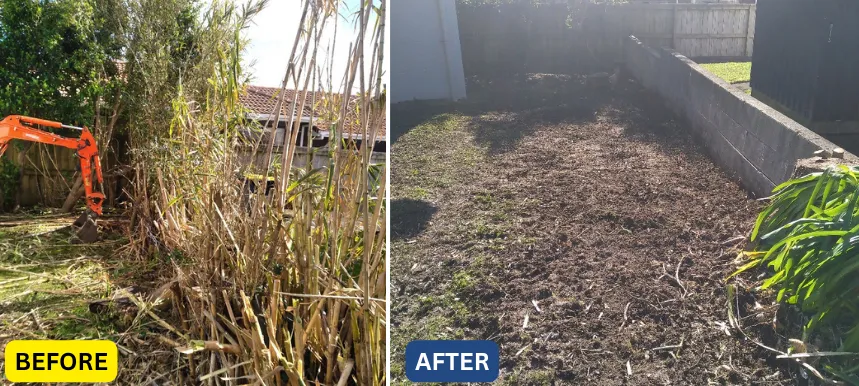
Bamboo can look great in a garden, but once it starts spreading beyond where it was planted, it can become a real headache. That's exactly what happened at a residential property in Māngere, South Auckland, where bamboo growing on the owner's section had started spreading towards the neighbour's property.
The customer contacted us for bamboo removal in Māngere, wanting to get the growth under control before it continued spreading.
This wasn't a simple case of cutting back a few bamboo stems. We needed to tackle the growth above ground and then get access to the extensive root system underneath.
Our garden team went in first to cut down the bamboo. Once the area was cleared enough for machinery, we brought in the digger to tackle the roots.
The job took approximately one and a half days and produced a substantial 24 cubic metres of waste, all of which we disposed of. The total cost was $3,400.
We've been tackling difficult property maintenance jobs since 2004, and this is a good example of why stubborn vegetation sometimes needs more than a pair of loppers and a trailer.
Project Overview
Bamboo Spreading Towards a Neighbouring Property
The customer had bamboo growing on their residential section in Māngere.
Over time, the bamboo had started spreading towards the neighbouring property, creating a problem the owner wanted sorted.
Bamboo can be particularly troublesome when it grows beyond its intended area. Certain varieties spread underground through rhizomes, which are horizontal stems capable of producing new shoots.
Auckland Council explains the difference between clumping bamboo and running bamboo in its guidance on invasive bamboo in Auckland. Running varieties can spread across property boundaries and become expensive to manage when left unchecked.
OurAuckland
For our Māngere customer, the main concern was the bamboo moving towards the neighbour's section.
They wanted the unwanted growth removed, including the underground root system, rather than simply having the stems cut back.
Project at a glance
Location
Māngere, South Auckland
Property
Residential section
Total project cost
$3,400
NZD, including disposal
Project duration
1.5 days
Approximately
Waste removed
24 m³
Cubic metres
Teams involved
Garden team and digger operator
Scope of Work
Cutting the Bamboo Before Excavating the Roots
This project required two different types of work: clearing the bamboo above ground and dealing with the root system below.
We couldn't simply bring in the digger and start excavating. The standing bamboo first needed to be cut down so the machinery could get to the roots.
That's where having our garden team and excavation services working together made a difference.
1. Cutting Down the Bamboo
Our garden team was sent in first.
Their job was to cut down the standing bamboo, clearing the vegetation that was in the way of the excavation work.
This initial stage was important because dense bamboo growth can restrict access and make it harder to reach the underground roots.
Our garden maintenance and vegetation clearing services cover the sort of stubborn plant removal that ordinary garden maintenance doesn't always address.
2. Excavating the Root System
Once the bamboo had been cut down, we could get the digger into the work area.
Bamboo's underground root and rhizome network is often the hardest part of a removal job.
Simply cutting the visible stems doesn't necessarily stop the plant from returning, particularly with running bamboo varieties.
The digger allowed us to tackle the underground growth that couldn't be effectively addressed by cutting the foliage alone.
Our digger and excavation services are suited to projects requiring machinery for vegetation removal, root excavation and section clearing.
3. Removing and Disposing of the Waste
By the time we'd completed the work, we'd generated 24 cubic metres of bamboo waste.
That is a substantial volume of material to remove from a residential property.
Disposal was part of the agreed project, so the customer wasn't left with piles of cut bamboo and excavated root material.
Our teams completed the bamboo removal and waste disposal over approximately one and a half days.
Challenges Overcome
Dense Bamboo Had to Be Cleared Before the Digger Could Work
The biggest challenge was the order in which the job needed to happen.
The bamboo growing above ground was in the way of the root system we needed to reach.
There was no point sending the digger straight in without first clearing the standing vegetation.
That's why we sent our garden team ahead of the excavation work.
They tackled the cutting first, opening up the area so the digger could get access.
It's a practical approach we've learned from working on stubborn garden-clearing jobs. Sometimes the best way to get machinery working efficiently is to do the preparation properly.
The Root System Was a Bigger Job Than Cutting the Stems
Bamboo can be deceptive.
You see the tall stems and leaves, but the real challenge is often underneath.
Running bamboo spreads through underground rhizomes, and leaving those in the ground can allow new shoots to emerge.
That was why the customer needed more than just the bamboo cut down.
We used the digger to address the underground root system after our garden team had cleared the area above.
For NZ property owners dealing with the same problem, Auckland Council's bamboo control advice is useful reading. It explains why unmanaged running bamboo can become a problem for adjoining properties.
OurAuckland
Managing 24 Cubic Metres of Bamboo Waste
The other big challenge was waste volume.
Once bamboo has been cut down and the roots excavated, there's often far more material to remove than the standing plants first suggest.
In this case, we ended up with 24 cubic metres of waste.
To put that into perspective, that's the volume of a space measuring four metres long, three metres wide and two metres high.
What 24 cubic metres looks like
Illustrative volume comparison only, not the shape or dimensions of the actual waste load.
Having the waste removed and disposed of was a significant part of the overall job.
For customers, this is worth remembering when getting a bamboo removal quote. The cutting and digging may be only part of the cost. Loading, transporting and disposing of large volumes of waste also need to be considered.
Working Near a Property Boundary
The customer contacted us because the bamboo was spreading towards the neighbour's property.
That made dealing with the problem particularly important.
Vegetation crossing property boundaries can create tension between neighbours, especially when underground roots continue spreading.
Our work focused on removing the unwanted bamboo from the customer's section.
Before excavating near boundaries, it's important to know where fences, underground services and neighbouring structures are located.
WorkSafe New Zealand's excavation safety guidelines explain why underground service checks, suitable equipment and safe excavation practices matter when using machinery.
WorkSafe
Project Execution
Our Three-Step Approach to the Māngere Bamboo Removal
This project worked because we completed the tasks in the right order.
Rather than trying to do everything at once, we used our garden team for the initial cutting and then brought in the digger for the underground work.
Step 1: Job Evaluation
The customer wanted the bamboo removed because it was spreading from their section towards the neighbouring property.
The work required more than a garden trim. We needed to remove the above-ground bamboo first so we could reach the root system with a digger.
That gave us a practical sequence for the job: cut the bamboo, excavate the roots and dispose of the waste.
Step 2: Work Begins
Our garden team went in first and began cutting down the bamboo.
Once that initial clearing was completed, we could get the digger to the root system.
This was the important second stage. Bamboo can keep growing from underground rhizomes, so cutting the stems alone may not provide a lasting solution.
With the area opened up, we used the digger to excavate the root growth.
The garden team and excavation work complemented each other. One stage made the next possible.
Step 3: Completion Check and Waste Removal
By the end of the project, we'd removed and disposed of approximately 24 cubic metres of bamboo waste.
The work took around one and a half days, with a total project cost of $3,400.
The completed work included cutting down the bamboo, using the digger to tackle the roots and disposing of the resulting vegetation and root material.
This is one of the advantages of coordinating garden clearing, excavation and rubbish removal services as part of the same job.
The customer didn't need to arrange separate contractors for each stage of the work.
Client Experience
Tackling the Bamboo Before It Spread Further
The customer's main concern was that bamboo growing on their section was spreading towards the neighbouring property.
Rather than leaving the situation to get worse, they arranged to have the unwanted growth removed.
Our team carried out the work in two stages. The garden crew handled the cutting, followed by the digger work to reach the roots.
The amount of waste was significant. Removing 24 cubic metres of vegetation and root material took care of a major part of the problem.
For the customer, the value was having the cutting, digging and disposal handled through one coordinated project.
The cost was $3,400, and the work was completed in approximately one and a half days.
We haven't been given a written customer testimonial for this project, so we won't claim a particular satisfaction rating or quote.
What we can confirm is that the agreed bamboo removal and waste disposal work was completed.
There's something satisfying about jobs like this. You start with an overgrown section that's causing a problem, and by working through the different stages, you remove a substantial amount of unwanted vegetation.
Final Thoughts
Why Proper Bamboo Removal Matters
This Māngere job shows why established bamboo can be more complicated to remove than it first appears.
The visible stems were only part of the work. We needed to cut the bamboo down before the digger could access the underground root system.
Using our garden team and digger in sequence allowed us to tackle both parts of the job.
Over approximately one and a half days, we removed and disposed of 24 cubic metres of waste for a total cost of $3,400.
For homeowners with bamboo spreading towards neighbouring properties, our advice is to deal with the growth before it becomes more established.
It's also important to understand that cutting bamboo down is not necessarily the same as getting rid of it. Depending on the species, underground rhizomes can produce new shoots, and follow-up monitoring may be needed.
If you're arranging professional bamboo removal, ask whether the quote includes the cutting, root excavation, waste disposal and any agreed reinstatement work. That way, you know exactly what you're paying for.
We've been helping Kiwi property owners with maintenance and outdoor clearing since 2004. From Māngere and South Auckland to the North Shore and West Auckland, we understand how frustrating stubborn vegetation can be.
Have bamboo spreading across your section?
Give us a call on 0800 514 514 or request a free, no-obligation quote.
We can discuss the amount of bamboo, access for machinery and what's involved in removing the plants and roots.
FAQ
1. How much does bamboo removal cost in Auckland?
Our Māngere bamboo removal project cost $3,400 NZD, including the cutting, digger work and disposal of approximately 24 cubic metres of waste. That's the price for this particular project, not a standard bamboo removal rate. Costs vary depending on the area covered, root density, machinery access and disposal volume. We recommend getting a quote that covers the complete removal process rather than just cutting the bamboo.
2. How long does it take to remove bamboo from a residential property?
We completed this Māngere project in approximately one and a half days. Our garden team cut the bamboo first, then we used a digger to tackle the roots. Other jobs may take longer or shorter depending on the size of the bamboo stand, the root network and property access. We assess the work before estimating the time required.
3. Can bamboo grow back after being cut down?
Yes. Some bamboo species spread through underground rhizomes that can continue producing new shoots after the stems are cut. That's why cutting bamboo at ground level doesn't always solve the problem. We used a digger to tackle the underground root system on our Māngere project. Even after excavation, we recommend monitoring for new growth, as any remaining viable rhizomes may regenerate.
4. Can you remove bamboo growing close to a neighbour's fence?
We can assess bamboo removal near property boundaries, but the work needs careful planning. Our Māngere customer contacted us because bamboo was spreading towards the neighbouring property. Before excavating, it's important to establish the boundary, check for underground services and consider nearby structures. We also recommend discussing access with your neighbour if any work may affect their property.
5. Do you need a digger to remove bamboo roots?
Not always. Small, recently established bamboo clumps may be manageable with hand tools, but extensive root systems can require machinery. On our Māngere project, the bamboo first had to be cut down so we could get the digger to the roots. We assess each property to determine whether manual removal, machinery or a combination of both makes the most sense.
6. Do you take away the bamboo after removing it?
Yes. Waste disposal was included in our Māngere project, where we removed approximately 24 cubic metres of bamboo and root material. That's a substantial amount of waste for a residential job. When quoting similar work, we recommend confirming that transport and disposal are included. Otherwise, homeowners can find themselves with a large pile of cut bamboo to organise removal for.