
· Williams Digger Services
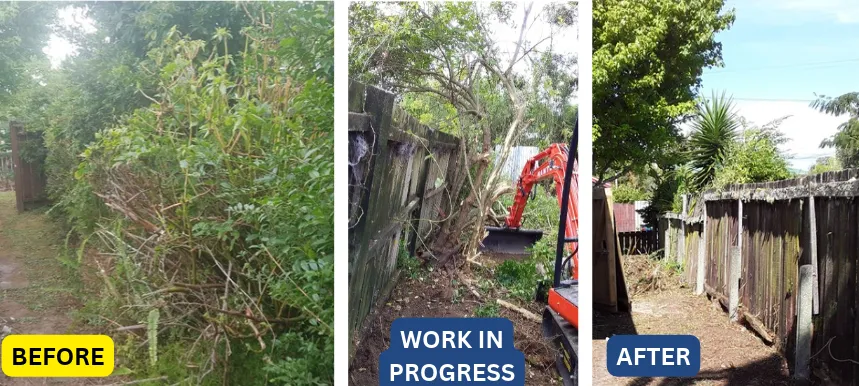
Fence Line Clearing: Bamboo and Tree Removal in Ponsonby
Buying a do-up property in Auckland can be exciting, especially when you've got plans to turn it into something special. But before the renovations can begin, there's often a fair bit of clearing to get through.
Our team recently completed a fence line clearing project in Ponsonby, Auckland, helping new homeowners prepare their property for a new fence installation.
The customers had recently purchased a property that needed some work. Along the existing fence line, non-native trees and bamboo had taken over, with root systems that needed removing before the new fence could be installed.
We provided an on-site quote of $1,450, including the removal and disposal of the unwanted vegetation and roots. We estimated the job would take at least four hours.
The customers accepted, and we attended the following day with our digger and empty truck.
Before excavation, we requested a beforeUdig assessment. The property plans supplied did not show any underground cabling or water pipes along the fence line where we planned to work.
With access organised by our Timber Fencing Guys, we uplifted the non-native trees and bamboo and excavated the bamboo root system, with the aim of eradicating it and preventing future regrowth. We scraped the ground and loaded the removed material onto our waiting truck.
Once the clearing was completed, our fencing team reinstated the wing fence.
We completed the work within the quoted timeframe, leaving the customers very pleased with how quickly we'd got the job sorted.
With more than 20 years of experience looking after Kiwi properties, we know that getting the groundwork right can make the next stage of a renovation much easier.
Project Overview
Preparing a Ponsonby Do-Up for a New Fence
Our customers had recently purchased a residential property in Ponsonby, one of Auckland's established inner-city suburbs.
Like many people buying a do-up, they had plans to improve the property, starting with a new fence.
Before the fence could go in, however, the existing fence line needed clearing.
Non-native trees, bamboo and their underground root systems were occupying the area where the new fence was planned.
The customers contacted us because they needed more than a basic garden tidy-up. They wanted the vegetation uplifted, the bamboo root system eradicated to prevent regrowth, and the affected ground scraped clear so they could move ahead with their fencing plans.
We visited the property to assess the job and provide a quote.
After looking at what needed removing and the machinery required, we quoted $1,450, including disposal, and advised that the clearance would take at least four hours.
The customers accepted and explained the access arrangements for our digger.
Before starting the excavation work, we requested a beforeUdig assessment. The plans provided did not identify cabling or water pipes along the section of fence line requiring clearance.
We arranged to attend the following day with the necessary equipment.
Project at a Glance
| Project detail | Description |
|---|---|
| Location | Ponsonby, Auckland |
| Property type | Residential do-up |
| Customer's goal | Clear the fence line for a new fence and prevent bamboo regrowth |
| Main issue | Non-native trees, bamboo and underground roots |
| Service | Fence line clearing and root system eradication |
| Equipment | Digger and truck |
| Additional trade | Builder from our Timber Fencing Guys |
| Site access | Temporary removal of wing fence |
| Underground service check | beforeUdig assessment requested |
| Assessment finding | No cabling or water pipes shown on supplied plans along the work area |
| Agreed price | $1,450 NZD, including disposal |
| Estimated timeframe | At least 4 hours |
| Actual completion | Within the quoted timeframe |
| Scheduling | Attended the following day |
| Final result | Non-native trees removed, bamboo root system excavated to prevent regrowth, ground scraped and wing fence reinstated |
| Customer feedback | Very pleased with the quick turnaround |
Scope of Work
What Our Ponsonby Fence Line Clearing Included
This wasn't simply about cutting back a few branches or trimming plants that had grown too close to the fence.
The customers were preparing for a new fence installation, so the underground growth needed attention as well.
Bamboo can develop spreading underground rhizomes, while established trees may have roots extending through the proposed fence line.
That can make preparation more involved than removing the visible vegetation.
The trees identified for removal were non-native species. However, even non-native trees may be subject to local protection rules, so their status should be checked before removal.
Our scope included:
- On-site assessment and quotation: Visiting the property to review the vegetation, access requirements and removal work.
- Underground service assessment: Requesting a beforeUdig assessment and reviewing the property plans, which showed no cabling or water pipes along the affected fence line.
- Temporary wing fence removal: Having our builder dismantle the wing fence so the digger could access the work area.
- Non-native tree uplift: Using our digger to remove the unwanted trees along the fence line.
- Bamboo removal: Uplifting the bamboo growth and associated underground material.
- Bamboo root system eradication: Excavating and scraping the affected ground to remove the bamboo's underground root and rhizome system, with the aim of preventing future regrowth.
- Waste loading: Loading the uplifted vegetation and root material onto our waiting truck.
- Waste disposal: Removing the unwanted material from the property for disposal.
- Fence line preparation: Leaving the affected ground scraped and cleared for the customers' planned fencing work.
- Wing fence reinstatement: Our Timber Fencing Guys reinstated the wing fence once the digger clearance was completed.
The important thing was to complete the work the customers actually needed.
They weren't asking us for a full garden renovation or new landscaping. They wanted the fence line cleared and the bamboo root system dealt with so they could move forward with the next stage of improving their property.
Our garden services and section clearing team handles outdoor clearing work for Auckland homeowners, including unwanted vegetation removal and land preparation.
We also provide rubbish and waste removal services when unwanted garden material needs collecting and disposing of.
Why Eradicating Bamboo Roots Matters Before Fence Installation
One thing we've learned over the years is that clearing the top of a fence line doesn't always mean the ground underneath is ready.
Bamboo is a good example.
Depending on the variety, bamboo can spread through underground rhizomes. These can extend beyond the visible clump and produce new shoots if viable sections remain in the soil.
Simply cutting bamboo down to ground level may leave the underground system intact, allowing new shoots to emerge.
For this Ponsonby project, the customers wanted more than the visible bamboo removed. They wanted the underground root system eradicated to avoid the plants returning and interfering with their planned new fence.
We used our digger to excavate the bamboo and work through the affected ground, uplifting the rootage and scraping out the unwanted underground material.
This approach was intended to address the source of potential regrowth rather than just the growth above ground.
Although we carried out the root system eradication work within the agreed area, future regrowth cannot be ruled out if viable rhizomes remain beyond the excavation boundary. Monitoring the cleared area is a sensible precaution.
Challenges Overcome
Getting Machinery Access Through the Wing Fence
One of the first things we needed to organise was access for our digger.
The existing wing fence restricted the route into the area where the vegetation needed clearing.
Fortunately, this was relatively straightforward to resolve.
We had our builder from the Timber Fencing Guys available to dismantle the wing fence, creating enough access for the machinery.
Once that section was out of the way, the digger could reach the fence line and we could get stuck into the main clearance work.
Having access sorted made a real difference to how efficiently we could complete the project.
After the vegetation and root clearance was finished, our Timber Fencing Guys reinstated the wing fence.
This meant the customers weren't left with an additional fencing job to organise after the machinery work.
Our timber fencing specialists handle fence construction, repairs and fence line clearing across Auckland, so coordinating fencing-related work with vegetation removal is a practical fit for our team.
Removing Non-Native Trees and Eradicating Bamboo Roots
The next challenge was the vegetation itself.
Unlike clearing grass or smaller garden plants, this job involved non-native trees mixed with bamboo growth.
The customers needed the underground rootage dealt with because they were planning a new fence along the cleared line.
An important part of our work was eradicating the bamboo root system within the affected excavation area to prevent regrowth.
We used our digger to uplift the non-native trees and bamboo mixture, then worked through the ground to excavate the underground bamboo roots and rhizomes.
We scraped the affected ground to remove the unwanted root material rather than simply cutting the bamboo back.
This was particularly important for the customers because they didn't want new bamboo growth appearing around their planned fence.
By focusing on the underground growth as well as the visible vegetation, we could provide the thorough clearance the customers had requested.
We loaded the removed material directly onto our truck for disposal, rather than leaving piles of green waste for the homeowners to deal with.
Checking for Underground Services Before Digging
When we're working with a digger on an established residential property, we need to consider what may be underground before breaking ground.
Power cables, water pipes, telecommunications and drainage infrastructure can all run through residential sections.
For this Ponsonby project, we requested a beforeUdig assessment before excavation began.
The property plans supplied did not show any underground cabling or water pipes along the fence line where we were removing the non-native trees and bamboo roots.
That was useful information when preparing for the excavation work.
However, it's important to understand that underground service plans aren't a guarantee that every buried service has been identified. Private connections, unrecorded infrastructure or variations from the plans may still exist.
The WorkSafe NZ excavation safety guidelines explain the importance of identifying underground services and managing the risks associated with excavation.
For homeowners planning similar work, beforeUdig New Zealand is a useful starting point for requesting information about buried infrastructure.
In our experience, checking what's below the ground is just as important as planning what needs removing above it.
Keeping the Job Within the Quoted Time
We had told the customers the clearance would take at least four hours.
When we arrived the following day, we had our digger and empty truck ready, with the access arrangement already discussed.
The wing fence removal meant we could get the machinery into position without unnecessary delays.
From there, we worked through the vegetation, excavated the bamboo root system, scraped the ground and loaded the material onto the truck.
Once the digger work was finished, we reinstated the wing fence.
The job was completed within the timeframe we'd quoted.
For customers who had recently purchased a property and were planning more renovation work, that quick turnaround was a welcome result.
Project Execution
How We Completed the Ponsonby Fence Line Clearance
We worked through three main stages: evaluating the job, carrying out the clearance and reviewing the completed result.
Step 1: Job Evaluation and Planning
The customers explained that they had recently purchased a do-up property and wanted the existing fence line cleared before installing a new fence.
We attended the property to provide an on-site quote.
During that visit, we considered the non-native trees, bamboo and underground rootage requiring removal.
We quoted $1,450, including disposal, and advised that the work would take at least four hours.
The customers accepted and explained the proposed digger access.
Before excavation, we requested a beforeUdig assessment. The property plans did not show cabling or water pipes along the affected fence line.
We then organised the machinery, truck and builder needed for the following day's work.
Having the equipment and access requirements arranged before arriving meant we could focus on the clearance itself.
Step 2: Work Begins
We arrived the following day with our digger and an empty truck.
Our builder from the Timber Fencing Guys started by dismantling the wing fence to create machinery access.
With the access sorted, we brought the digger through and began uplifting the unwanted non-native trees and bamboo.
The bamboo required more than cutting back. Our aim was to eradicate the root system within the work area so it wouldn't regrow and interfere with the customer's new fence.
We excavated the bamboo growth and associated rhizomes, working along the affected fence line to uplift the underground material.
We then scraped the ground to remove the remaining rootage identified within the area being cleared.
As the vegetation and roots came out, we loaded the waste onto our waiting truck.
That meant we could take care of the excavation and waste removal during the same visit.
The customers didn't have to organise a separate green waste collection after we'd finished.
Step 3: Completion Check and Final Result
Once we'd uplifted the non-native trees and bamboo, we completed the ground scraping and root system clearance required for the agreed work.
Our focus was on removing the bamboo's underground growth from the affected fence line to minimise the risk of it returning.
The removed material was loaded onto our truck and taken away for disposal.
With the digger work completed, our Timber Fencing Guys reinstated the wing fence that had been temporarily removed for access.
This was an important finishing step, as it meant the property was left with its existing wing fence back in place while the customers prepared for their new fence installation.
By the end of the job, we had:
- Requested a beforeUdig assessment and reviewed plans showing no cabling or water pipes along the work area.
- Removed the unwanted non-native trees along the fence line.
- Uplifted the bamboo growth.
- Excavated and removed the affected bamboo root and rhizome system to prevent regrowth.
- Scraped the ground to remove unwanted underground material.
- Loaded the vegetation and roots onto our truck.
- Arranged disposal of the removed material.
- Cleared the affected area for the planned new fence.
- Reinstated the wing fence after completing the excavation.
- Completed the work within the quoted timeframe.
The customers could now move forward with the next stage of their fencing project.
Our responsibility was the vegetation and root clearance, together with reinstating the wing fence used for machinery access, not installing the proposed new boundary fence.
Client Experience
A Quick Result for New Ponsonby Homeowners
For these customers, the main benefit was getting an important part of their renovation sorted without a long delay.
They had recently purchased the property and wanted to install a new fence, but the existing vegetation was in the way.
They were also keen to have the bamboo roots removed thoroughly to avoid having the same problem return after their new fence was installed.
We provided an on-site quote, arranged to attend the following day and completed the work within the time we'd advised.
The customers were particularly pleased with how quickly we got the job done.
Instead of being left with non-native trees, bamboo and a difficult fence line to clear, they had an area where we'd excavated the rootage, scraped the ground and removed the unwanted material.
Their wing fence was also back in place, so there wasn't an additional reinstatement job left outstanding.
That's the sort of practical result we take pride in.
A job doesn't need to be a large renovation to make a difference. Sometimes getting one awkward task out of the way is exactly what a property owner needs.
Why This Project Worked Well
Four things helped this Ponsonby project run smoothly.
A clear quote and timeframe: We provided an on-site price of $1,450 and advised the customers how much time to allow.
Checking underground services: We requested a beforeUdig assessment and reviewed plans that did not identify cabling or water pipes along the proposed excavation area.
Thorough root removal: We excavated the bamboo's underground root system within the affected area, aiming to eradicate it and avoid future regrowth around the new fence.
Coordinated machinery and fencing work: Our builder dismantled the wing fence, our digger and truck handled the vegetation and waste, and our fencing team reinstated the fence afterwards.
The customers were happy with both the speed and the completed clearance.
Final Thoughts
Need Fence Line Clearing in Ponsonby or Auckland?
This Ponsonby fence line clearing project is a good reminder that the work involved in a new fence often starts before the first post goes in.
Our customers had recently purchased a do-up and wanted to make improvements, starting with their fencing.
The existing fence line contained non-native trees, bamboo and root systems that needed removing.
One of the key objectives was to eradicate the bamboo root system within the proposed fence line, helping prevent regrowth after the new fence was installed.
We provided an on-site quote of $1,450, requested a beforeUdig assessment, and returned the following day with our digger and truck.
After reviewing the property plans, which did not show cabling or water pipes along the affected fence line, we carried out the clearance and reinstated the temporary wing fence.
The job was completed within the quoted timeframe of around four hours, and the customers were pleased with the result.
For other Auckland homeowners planning a new fence, it's worth assessing the vegetation and underground conditions before booking installation.
Trees, bamboo roots and old landscaping can all affect how easily fence posts can be installed.
If bamboo is present, simply cutting the visible growth may not be enough. Removing the underground root and rhizome system can help prevent future regrowth, although follow-up monitoring may still be needed.
It's also worth checking for underground services before excavation begins, even if the area appears straightforward.
Even when trees are non-native, that doesn't automatically mean they can be removed without restrictions. The species, location and any applicable protection rules should be checked before work begins.
You may also need to consider boundary ownership, neighbour discussions and any applicable fencing rules. New Zealand's Fencing Act 1978 provides the legal framework for dividing fences, including obligations between adjoining property owners.
Our team helps homeowners across Auckland, including Ponsonby and surrounding suburbs, with digger work, section clearing, vegetation removal and fencing-related property maintenance. We also provide wider property services in Hamilton and Wellington.
If you're planning a fence replacement and need the existing vegetation cleared first, get in touch with our team for a free, no-obligation quote.
We can assess what's in the way, look at machinery access and help get the fence line ready for the next stage of your project.
FAQ
1. How much does fence line clearing cost in Ponsonby?
Our Ponsonby fence line clearing project was quoted at $1,450, including non-native tree and bamboo uplift, root removal and disposal. This was the price for that particular property, not a standard rate. Other jobs may cost more or less depending on the amount of vegetation, root systems, access and machinery requirements. We recommend an on-site assessment for a more accurate quote.
2. How long does it take to clear a fence line before installing a new fence?
For this Ponsonby project, we estimated at least four hours and completed the work within the quoted timeframe. Larger jobs may take longer, particularly where bamboo has spread extensively or access is restricted. We assess the amount of vegetation, underground rootage and equipment access before advising on timing. Clearing the area in advance can make the following fencing work more straightforward.
3. Do you check for underground services before using a digger?
Yes, underground service information is an important part of planning excavation work. For our Ponsonby project, we requested a beforeUdig assessment. The plans supplied showed no cabling or water pipes along the affected fence line. However, plans alone don't guarantee that no buried services are present. Depending on the site, further locating work and safe-digging precautions may be needed before excavation.
4. Can you eradicate bamboo roots to prevent regrowth before a new fence is installed?
Yes, bamboo root system eradication was an important part of our Ponsonby project. We used our digger to excavate and uplift the underground roots and rhizomes along the affected fence line, rather than simply cutting back the visible bamboo. Our goal was to prevent the bamboo from regrowing around the planned new fence. Because overlooked or neighbouring rhizomes can produce new shoots, we also recommend monitoring the area afterwards.
5. Can you remove and reinstate part of a fence to provide digger access?
Yes, where the existing fence and site conditions allow it. For this job, our builder from the Timber Fencing Guys dismantled a wing fence so our digger could access the work area. Once the clearance was completed, we reinstated the wing fence. We recommend planning machinery access before the job begins and agreeing on any necessary fence removal and reinstatement.
6. Can you remove non-native trees and dispose of the waste?
Yes, removing non-native trees was part of this Ponsonby project. We uplifted the unwanted trees and bamboo rootage, then loaded the material onto our truck for disposal. However, non-native status alone doesn't establish whether tree removal is permitted. We recommend checking applicable council rules and any relevant tree protections before starting. The exact removal scope and disposal costs should be included in the quotation.