
· Williams Digger Services
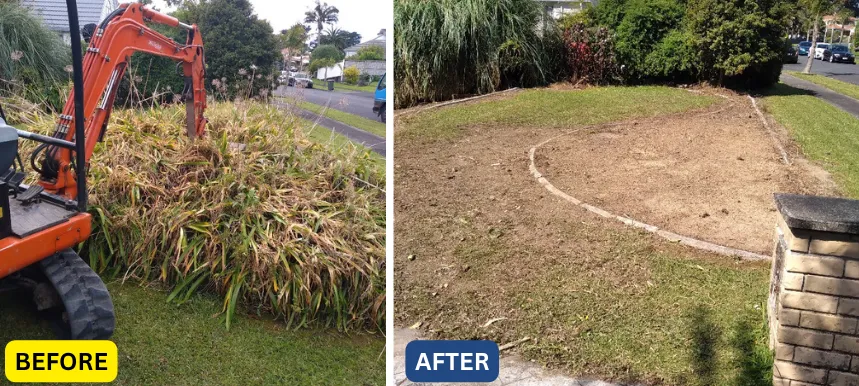
Agapanthus Removal: Clearing a Water Meter in Half Moon Bay
Sometimes a garden plant becomes more trouble than it's worth. That's what happened at a residential property in Half Moon Bay, East Auckland, where overgrown agapanthus was blocking access to the water meter.
The customer contacted us to arrange agapanthus removal in Half Moon Bay, wanting the plants and their heavy root systems removed from a sloping section of the property.
At first glance, agapanthus can look like a straightforward garden-clearing job. But anyone who's dug out an established clump knows there's often plenty of root material underneath.
This particular job was a little fiddly. The roots were heavy and tightly packed, and working on the slope added another challenge.
Our team got stuck in, removed the unwanted agapanthus and arranged disposal of the plant material. The work took approximately three hours and cost $1,450, including disposal.
With over 20 years of hands-on property maintenance experience since 2004, we're familiar with these awkward garden jobs. They're not always glamorous, but sorting out a practical problem for a homeowner is what we enjoy.
Project Overview
The customer had an established patch of agapanthus growing around the water meter at their Half Moon Bay property.
The plants had become an obstruction, making access to the meter difficult.
That matters because water meters need to remain accessible for readings, inspections and maintenance. Watercare advises Auckland homeowners to keep their meter boxes clear of overgrown gardens.
Watercare
The customer's request was straightforward: remove the agapanthus and take the unwanted material away.
What made this project more demanding was the location of the plants. They were growing on a sloping section, and their established root systems were substantial.
Rather than just cutting back the leaves, the job required dealing with the heavy, root-bound clumps.
Project at a glance
Location
Half Moon Bay, Auckland
Property type
Residential garden
Total cost
$1,450
NZD, including disposal
Job duration
Approx. 3 hours
Main challenge
Heavy roots on a slope
Service
Agapanthus removal and disposal
Scope of Work
Removing Established Agapanthus and Its Heavy Roots
The customer wasn't after a complete garden redesign. The priority was clearing the plants obstructing the water meter.
The work centred on three practical tasks.
1. Removing the agapanthus plants
We needed to clear the established agapanthus from the affected section rather than simply trim the foliage back.
Cutting the leaves would have made the plants look smaller temporarily, but it wouldn't have dealt with the bulky root clumps or properly addressed the obstruction.
2. Dealing with the heavy root systems
This was the fiddly part.
Established agapanthus forms dense, fleshy root systems. Once the plants have spread into a large clump, there's often much more to remove than the leaves you can see above ground.
On this job, the roots were particularly heavy, making removal more physically demanding.
3. Removing and disposing of the plant waste
The agreed price included disposal, so the customer wasn't left with a pile of uprooted agapanthus to deal with.
All three parts of the work were completed in approximately three hours.
For homeowners facing similar problems, our residential garden and outdoor maintenance services cover practical garden clearing and vegetation removal.
Williams Property Services
Challenges Overcome
Heavy, Root-Bound Agapanthus
Agapanthus is one of those plants that can be deceptively difficult to remove.
Above ground, you've got long leaves growing in thick clumps. Below ground, there can be a substantial mass of tightly packed roots.
The Half Moon Bay job was a good example.
The root systems were heavy, which made extracting and handling the plants more involved than a basic garden trim.
In our experience, this is where it's important to understand the difference between cutting a plant back and removing it.
Trimming leaves may improve the appearance of a garden, but if the problem is an established root clump obstructing access, pruning alone won't solve it.
Working on a Sloping Section
The second challenge was the slope.
Working on flat ground is generally easier when you're digging out heavy plants and moving the resulting waste. On a slope, the ground can be awkward underfoot, and lifting or shifting heavy root material requires additional care.
For this property, the combination of heavy roots and sloping ground made the work a little more fiddly than usual.
It's also why we wouldn't suggest every homeowner take on a large agapanthus removal job with a garden spade.
WorkSafe New Zealand highlights the importance of managing slips, trips, falls and manual-handling risks during vegetation work. These are useful considerations when dealing with heavy vegetation on sloping ground.
WorkSafe
Working Around the Water Meter
The third consideration was the meter itself.
Unlike clearing plants from an open garden bed, removing established vegetation near a utility fixture requires care.
A water meter isn't something you want to accidentally damage while digging through heavy roots.
Watercare explains that meters need clear access so crews can read them, investigate problems and carry out necessary maintenance. Its water meter access guidance also highlights the importance of a safe pathway and working space around the meter.
Watercare
For the customer, the reason for removing the agapanthus was clear: the plant growth was in the way, and it needed to go.
Project Execution
From Overgrown Plants to a Cleared Water Meter Area
Our approach to this job was straightforward: identify what needed removing, deal with the awkward roots and take the unwanted material away.
Step 1: Job Evaluation
The customer wanted the agapanthus removed because it was blocking their water meter.
Two details made this job different from a standard garden tidy-up: the heavy root systems and the sloping section where the plants were growing.
Both were important when considering the work involved.
The agreed scope was the removal of the unwanted plants and their disposal, at a total cost of $1,450.
Step 2: Work Begins
The main task was getting the established agapanthus out of the ground.
Unlike trimming hedges or mowing lawns, removing these plants involves dealing with the roots as well as the foliage.
The heavy root clumps made this part of the job more demanding. Working on the slope added to the effort, particularly when handling the uprooted material.
We worked through the removal and took the unwanted plants away from the property.
Our rubbish and green waste removal services are useful for jobs like this, where the volume or weight of garden waste makes disposal part of the project rather than an afterthought.
Williams Property Services
Step 3: Completion Check
The agapanthus removal and disposal work took approximately three hours.
By the end of the job, we'd removed the obstructing plants and dealt with the waste, completing the customer's requested removal work.
That's an important part of how we approach these smaller property maintenance jobs. There's no point digging out heavy plants if the homeowner is then left with the problem of getting rid of them.
Client Experience
Getting an Awkward Garden Problem Sorted
For this Half Moon Bay customer, the project wasn't about creating a fancy new garden.
It was about dealing with plants that had grown in the wrong place.
The agapanthus was obstructing the water meter, and the customer wanted it removed.
We completed the work, including disposal, in approximately three hours for the agreed $1,450.
The real value was taking care of a difficult, physical job that involved bulky roots and awkward sloping ground.
Sometimes that's exactly what a homeowner needs: someone to tackle the stubborn part of the garden without turning it into a much larger project.
We haven't been given a written testimonial from this customer, so we won't invent one. The confirmed outcome is that we completed the agapanthus removal and disposal requested.
It's a satisfying type of job for our team because the work has an immediate, practical purpose.
A section that was previously occupied by unwanted agapanthus is cleared, and the homeowner no longer has to deal with those plants themselves.
Final Thoughts
Keeping Water Meters Accessible in Auckland Gardens
This Half Moon Bay project is a reminder that even familiar garden plants can become a problem when they're growing too close to essential property services.
Agapanthus can be particularly stubborn once its roots are established.
Add a slope into the equation and what looks like a simple removal job can turn into a fair bit of hard work.
For this customer, we removed the obstructing agapanthus, dealt with the heavy root material and included disposal in the job. The work took approximately three hours and cost $1,450.
If you've got agapanthus spreading around a water meter, pathway, fence or garden boundary, we'd recommend addressing it before the plants become even more established.
It's also worth getting the whole job quoted, including the root removal and disposal, rather than just the foliage clearing.
We've been helping Kiwi homeowners with property maintenance since 2004, and jobs like this are part of our day-to-day work.
Whether you're in Half Moon Bay, Howick, Pakuranga or elsewhere in Auckland, our team can help assess unwanted vegetation and recommend a practical way to remove it.
Need stubborn agapanthus removed from your property?
Give us a call on 0800 514 514 or request a free, no-obligation quote. We can discuss the plants, access, slope and removal requirements before providing a price.
FAQ
1. How much does agapanthus removal cost in Auckland?
Our Half Moon Bay agapanthus removal job cost $1,450 NZD, including removal and disposal. This was the price for the particular site, not a fixed rate for every property. The cost of other jobs depends on the number of plants, the extent of the roots, ground conditions and access. We recommend getting a quote that clearly includes removing the plant material and disposing of it.
2. How long does it take to remove established agapanthus?
We completed this Half Moon Bay job in approximately three hours, despite the heavy roots and sloping ground. Other properties can take more or less time depending on how established the plants are, the area covered and accessibility. A small clump near a driveway may be relatively straightforward, while a larger, deeply rooted patch on uneven ground can require considerably more effort.
3. Why are agapanthus roots difficult to remove?
Established agapanthus develops thick, fleshy roots that can form a dense mass beneath the leaves. Those roots can be surprisingly heavy, particularly when the plants have been growing undisturbed for years. We've seen how much more work is involved once you begin dealing with the underground growth. Simply cutting the leaves doesn't remove the root system, which is why proper removal requires more effort.
4. Can agapanthus damage or block access to a water meter?
Agapanthus can grow densely enough to cover or obstruct a water meter box, making it difficult to access. That's what prompted our Half Moon Bay customer's request. Dense vegetation does not automatically mean the meter or pipes are damaged, but it can interfere with access. We recommend keeping the area clear and consulting Watercare or a qualified plumber if you suspect damage to underground pipework.
5. Can you remove agapanthus growing on a slope?
Yes. Our Half Moon Bay project involved removing heavy-rooted agapanthus from a sloping section. That made the work more fiddly than a straightforward garden clearance on level ground. Slope conditions can affect footing, excavation and the handling of heavy plant waste. We recommend assessing the site before removal, especially where the slope is steep or vegetation grows close to services or structures.
6. Do you dispose of the agapanthus after removing it?
Yes, disposal was included in the $1,450 price for this particular job. We removed the unwanted agapanthus and took the plant waste away from the property. When arranging similar work, it's worth confirming that disposal is included in your quote. Established root clumps can be bulky and heavy, making them difficult for homeowners to move or transport themselves.